
In this article
- What a Manhole Actually Needs Protecting Against
- Spray-Applied Coatings
- Cured-in-Place Liners
- Chimney Seals
- Comparing the Three Approaches
- Choosing the Right System for the Actual Problem
- Things to Consider Before Specifying a System
- Maintenance and Inspection After Rehabilitation
- Frequently Asked Questions
- Conclusion
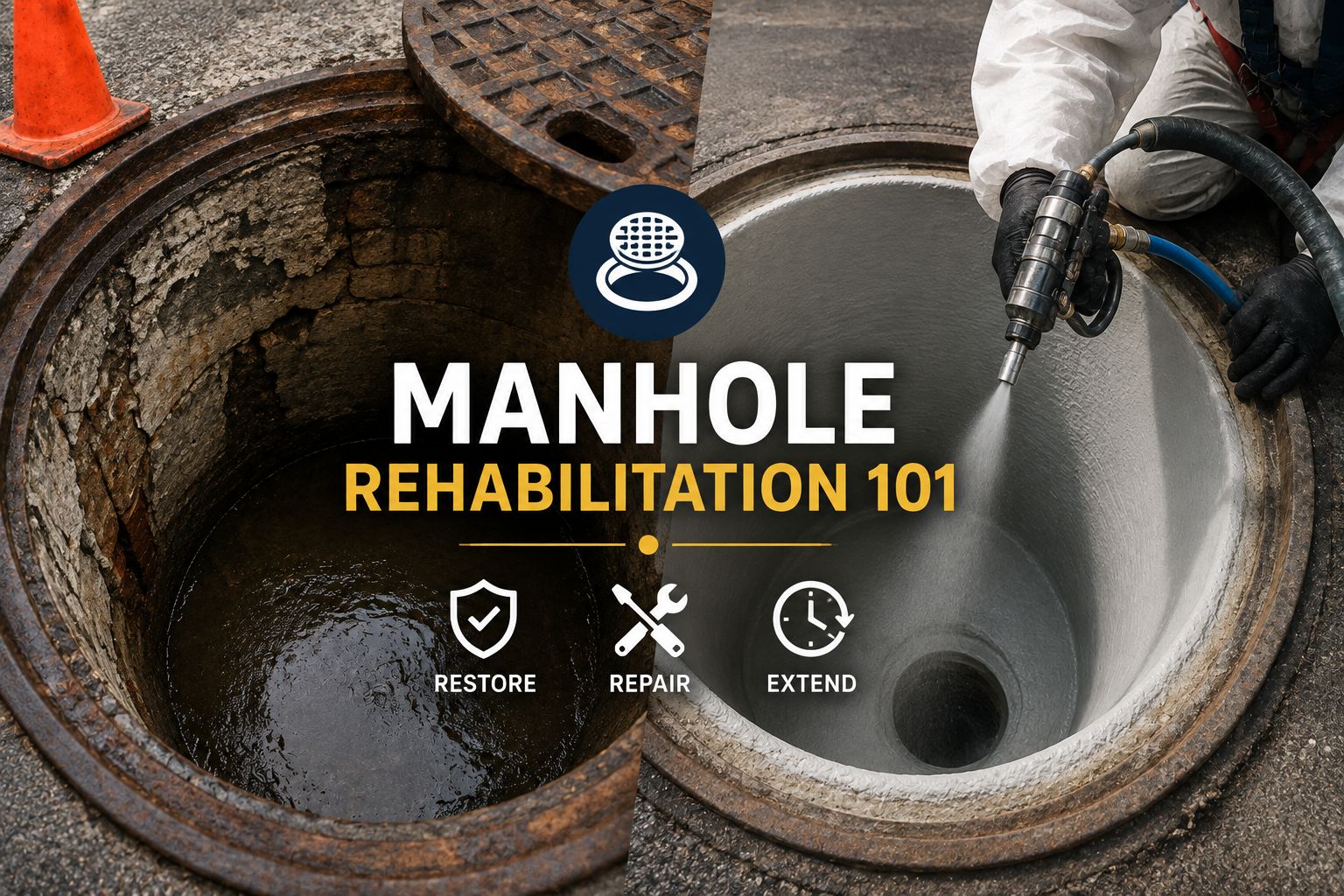
Ask five different utility engineers which manhole liner systems they trust and you’ll probably get three different answers, and all three might be right, just for different manholes. A manhole with active infiltration at the chimney is a different problem than a manhole with a sound structure but corroded walls, which is a different problem again from one with actual cracks and holes compromising its integrity. Coatings, cured-in-place liners, and chimney seals each solve a specific version of that problem well, and mixing them up, applying the wrong fix to the wrong failure mode, is one of the more common reasons a rehabilitated manhole shows the same symptoms again a few years later.
What a Manhole Actually Needs Protecting Against
Before comparing systems, it helps to be specific about what’s actually attacking a manhole over its service life. Hydrogen sulfide gas, produced by the wastewater itself, converts to sulfuric acid on exposed concrete surfaces and eats away at the structure from the inside, sometimes fast enough to be visible within a few years in a severe environment. Groundwater infiltration, particularly through cracks, joints, and the chimney section where grade rings and adjustment rings create multiple potential entry points, adds volume to the sewer system that treatment plants then have to process unnecessarily. And straightforward structural deterioration, cracking, spalling, and joint separation, can progress to the point where the manhole itself becomes a safety and stability concern, not just a water tightness one.
Different liner systems address different combinations of these problems, which is exactly why picking the right one starts with correctly diagnosing what’s actually wrong.
Spray-Applied Coatings
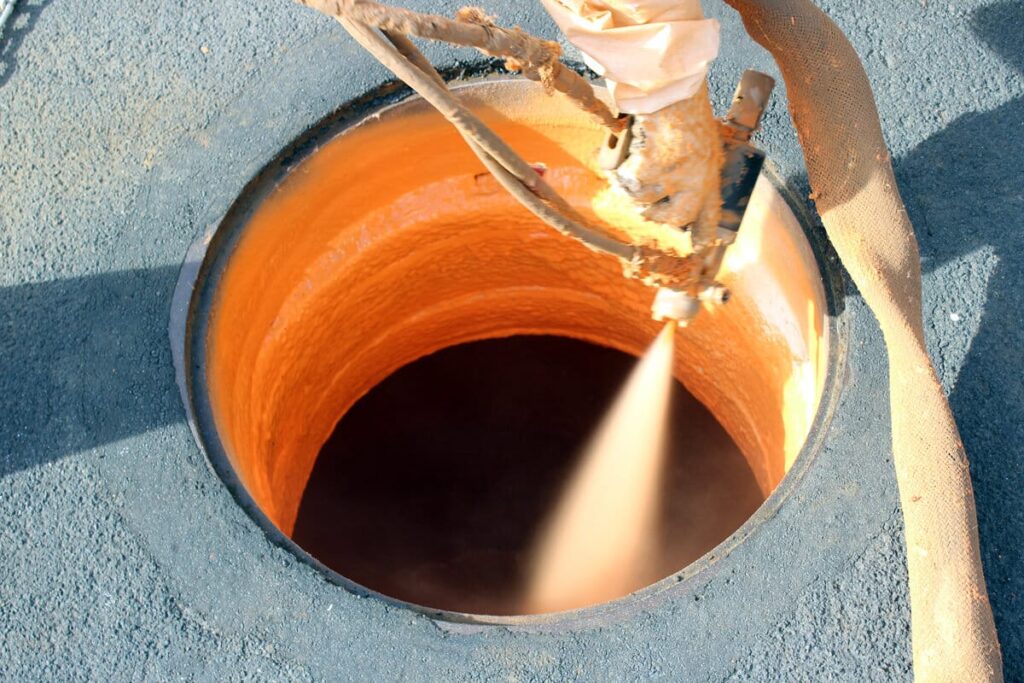
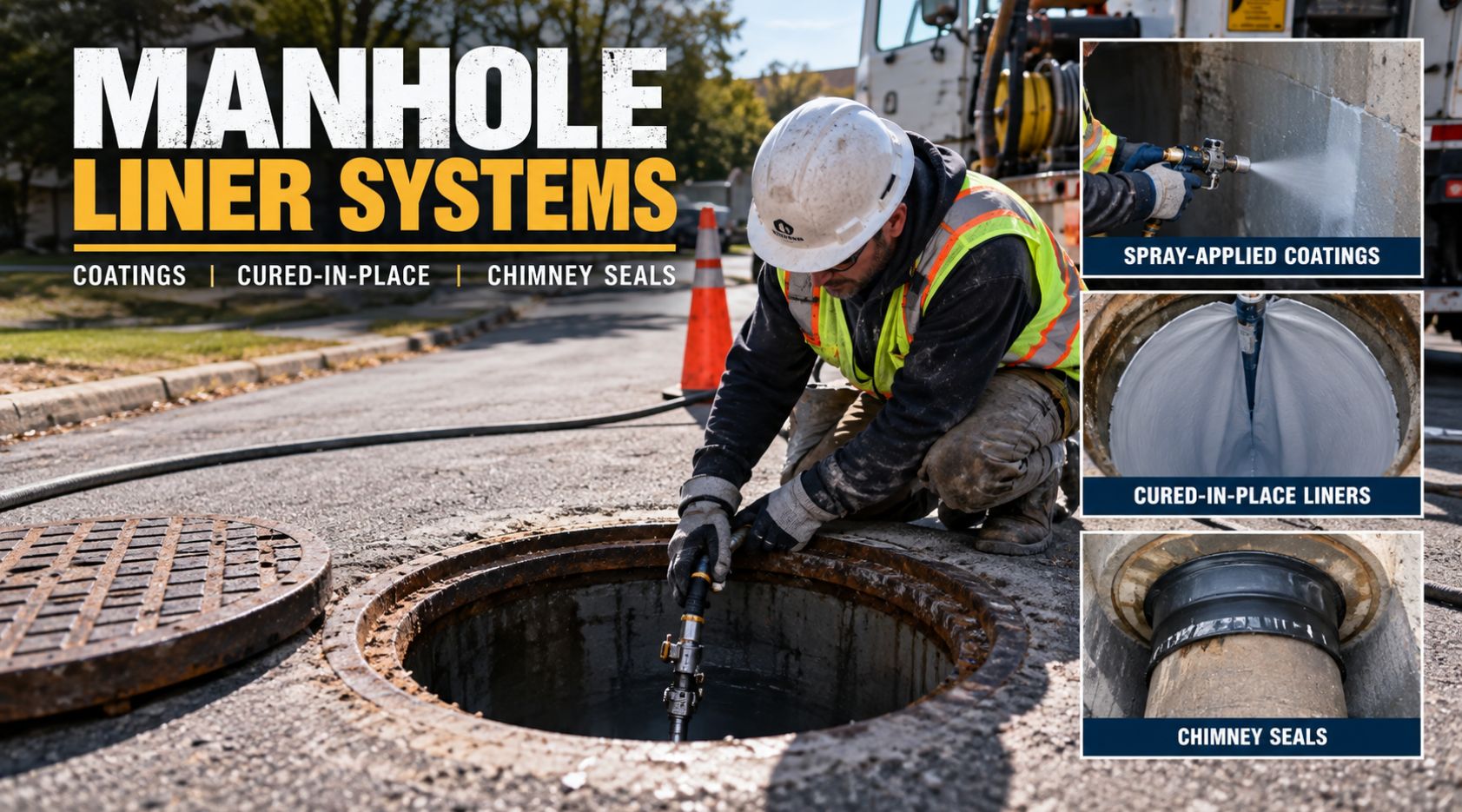
Spray-applied coatings, most commonly polyurea, polyurethane, or cementitious systems, go on as a liquid and cure into a continuous, seamless barrier over the interior surface. Polyurea in particular has become common for this application because it cures fast, bonds well even to a damp surface, which matters a great deal in an active sewer structure that’s rarely bone dry, and holds up well against both abrasion and the chemical attack from hydrogen sulfide conversion.
Coatings are primarily a barrier solution. They protect the existing structure from further chemical and moisture attack, and a good coating system can meaningfully extend a manhole’s service life by stopping active corrosion. What a coating generally does not do is add significant structural strength to a manhole that has real cracks, voids, or compromised wall integrity. A coating over a structural problem protects the surface while the underlying issue, if it’s serious enough, continues to exist beneath it.
Cured-in-Place Liners
Cured-in-place liner systems work differently. A liner, typically a felt or fabric tube impregnated with a resin, gets inserted into the manhole and then expanded, either by inflation or mechanical pressure, until it presses fully against the interior wall. The resin cures in place, creating what amounts to a new structural wall inside the old one.
This is the system to reach for when a manhole has actual structural deficiencies, not just surface corrosion. Because the cured liner forms its own load-bearing layer, it can address cracks, holes, and joint separation in a way a surface coating alone cannot. The tradeoff is complexity and cost. Cured-in-place installation typically takes more specialized equipment and a more involved process than spraying a coating, and getting a proper fit in a manhole with irregular geometry, tapers, and pipe penetrations takes real expertise to execute without leaving gaps or wrinkles that undermine the whole point of the liner.
Chimney Seals
The chimney, the section of a manhole between the top of the cone and the frame, made up of grade rings or adjustment rings, is disproportionately responsible for infiltration in a lot of collection systems. It’s also one of the more overlooked parts of the structure, since it’s a relatively small area compared to the barrel or base of the manhole but tends to accumulate multiple joints, each one a potential water entry point.
A chimney seal system, typically a stretchable sleeve inserted and pressed against the chimney walls with an inflatable bladder, then allowed to bond and cure, addresses this specific vulnerability directly. It’s a targeted repair rather than a whole-structure solution, and it’s often the most cost-effective fix available when infiltration testing points specifically to the chimney section rather than the barrel or base of the manhole.
Comparing the Three Approaches
| Factor | Spray-Applied Coating | Cured-in-Place Liner | Chimney Seal |
|---|---|---|---|
| Primary purpose | Chemical and moisture barrier | Structural renewal | Infiltration control at the chimney |
| Adds structural strength | Generally no | Yes | Limited, localized |
| Best suited for | Sound structure needing corrosion protection | Cracked, deteriorated, or structurally compromised walls | Infiltration concentrated at grade rings and joints |
| Typical scope | Full interior surface | Full interior surface | Chimney section only |
| Installation complexity | Moderate | Higher | Moderate |
| Relative cost per structure | Lower to moderate | Higher | Lower, targeted repair |
Choosing the Right System for the Actual Problem
The honest answer to “which manhole liner system is best” is that it depends entirely on what’s actually failing, which means diagnosis has to come before product selection, not after. A structure with confirmed cracking or documented structural deficiency, usually identified through visual inspection or a condition assessment, is a cured-in-place candidate, not a coating candidate, since a coating won’t resolve the underlying structural issue no matter how well it’s applied.
A structure with sound walls but active corrosion from hydrogen sulfide exposure, common in older systems handling wastewater with higher sulfide content, is generally a strong fit for a spray-applied coating, which addresses exactly that failure mode without the added cost and complexity of a full structural liner.
Infiltration testing, whether through visual inspection during wet weather, dyed water testing, or smoke testing, often reveals that a system’s infiltration problem is concentrated at chimney sections rather than distributed evenly across the barrel. In those cases, a chimney seal program targeting just the vulnerable sections can address a large share of a system’s total infiltration volume at a fraction of the cost of coating or lining every manhole in a district. Our piece on how municipalities are taking manhole recovery into their own hands with polyurea covers how cities have approached this kind of targeted, in-house rehabilitation work as budgets have tightened, and the underlying logic, matching the fix to the actual failure mode rather than defaulting to one approach everywhere, applies just as directly to choosing between these three systems.
Some manholes genuinely need more than one system. A structure with both chimney infiltration and general wall corrosion might reasonably get a chimney seal for the joints and a full coating for the barrel, addressing both problems rather than picking one fix and hoping it covers everything. Our earlier look at how modern manhole linings actually hold up underground touches on this same point: the goal isn’t finding one universal product, it’s matching the right barrier to the right failure mode.
It’s worth being honest about how often this diagnosis step gets skipped in practice. Budget pressure and a backlog of manholes needing attention push a lot of municipalities toward a single standard approach applied across an entire inspection district, regardless of what condition each individual structure is actually in. That approach isn’t necessarily wrong for every manhole in the batch, but it does mean some structures end up under-treated, receiving a coating when they needed structural renewal, while others get an unnecessarily expensive fix for a problem a simpler repair would have solved. A short, structured condition assessment before specifying a rehabilitation program, even a basic checklist covering visible cracking, active infiltration location, and general wall condition, tends to pay for itself by routing each manhole to the system that actually matches its failure mode.
Things to Consider Before Specifying a System
Get an accurate condition assessment first. Visual inspection, and ideally documented photo or video records, should identify whether a manhole’s problems are structural, chemical, infiltration-related, or some combination, before any system gets specified. Guessing at the failure mode leads directly to guessing at the fix.
Confirm confined space entry protocols are followed for any inspection or application work. Manhole work involves confined space entry with real atmospheric hazards, including hydrogen sulfide gas itself, and proper testing, ventilation, and entry procedures are not optional steps to skip for a faster job.
Ask about surface preparation requirements for coatings specifically. A coating applied over active corrosion, loose material, or contamination will fail regardless of how good the coating product itself is. Proper cleaning and surface preparation before any spray-applied system goes down matters as much here as it does on any other coating application.
Understand what warranty or service life expectation actually applies. Different systems and different manufacturers document different expected service lives, and that documentation should come from the specific product’s technical data, not a general assumption carried over from a different system entirely.
Factor in program scale, not just per-structure cost. A municipality rehabilitating hundreds of manholes benefits from thinking about which systems can be applied efficiently at scale, sometimes by in-house crews, versus which require specialized contractor equipment for every job, since that operational reality affects total program cost as much as the per-unit material price does.
Maintenance and Inspection After Rehabilitation
None of these systems eliminates the need for ongoing inspection. A coated manhole should still be checked periodically for signs of coating wear or new infiltration, particularly at penetrations and the coating’s termination points. A cured-in-place liner should be inspected for any signs of separation from the host structure over time. And a chimney seal, precisely because it’s a targeted repair rather than a whole-structure solution, should be checked to confirm infiltration hasn’t simply shifted to an adjacent, unaddressed section of the same manhole. Treating rehabilitation as the end of the maintenance story, rather than one point in an ongoing inspection cycle, is how avoidable failures end up looking like surprises years later.
Frequently Asked Questions
Can a coating be used instead of a cured-in-place liner to save money?
Only if the manhole doesn’t actually have a structural deficiency. A coating protects a sound structure from further chemical and moisture damage, but it doesn’t add structural strength, so using it on a manhole with real cracking or wall deterioration just delays a more serious problem rather than solving it.
How do you know if infiltration is coming from the chimney or somewhere else in the manhole?
Visual inspection during wet weather, dyed water testing, and smoke testing are the standard methods for identifying where infiltration is actually entering the structure, rather than assuming based on the manhole’s age or general condition.
Is it common to use more than one liner system on the same manhole?
Yes, particularly when a condition assessment identifies more than one failure mode, such as chimney infiltration combined with general wall corrosion. Combining a targeted chimney seal with a full-structure coating is a reasonably common approach in that situation.
How long do manhole liner systems typically last?
This varies significantly by system type, product, and the specific exposure conditions in a given manhole. The manufacturer’s technical documentation for the specific product installed is the reliable source for expected service life rather than a general industry assumption.
Do municipalities need specialized contractors for all of these systems?
Not necessarily. Spray-applied coatings, in particular, have become common for in-house municipal crews to apply after proper training, while cured-in-place liner installation more often involves specialized equipment and expertise that many municipalities still contract out.
Conclusion
Manhole liner systems aren’t interchangeable, and the industry’s move toward proactive, in-house rehabilitation programs has made getting that distinction right more important, not less. Coatings protect a sound structure from ongoing chemical and moisture attack. Cured-in-place liners renew actual structural integrity. Chimney seals target the specific, often disproportionate infiltration risk sitting at the grade rings. Matching the system to an accurate diagnosis of what’s actually failing, rather than defaulting to whichever approach is most familiar, is what determines whether a rehabilitated manhole actually stays fixed.
Thinking about spraying manhole coatings?
Tell us a little about your plans and ArmorThane will send startup costs, spray rig options and material pricing for your area.
- Startup cost & spray rig options
- Hands-on training on the ArmorThane system
- Material pricing for your territory
Was this article helpful?
Thanks for the feedback!

Written by
Heidi Lee
Heidi Lee is a licensed Professional Engineer (PE) with 18+ years of experience in municipal infrastructure management and underground utility rehabilitation. She serves as Executive Director of Manhole Recovery and has overseen rehabilitation programs totaling more than $200 million in public works investment across more than 30 municipalities in the United States and Canada. Heidi holds a BS and MS in Civil Engineering, serves on the American Society of Civil Engineers infrastructure committee, and is a member of the American Public Works Association (APWA) and the Water Environment Federation (WEF). Her work focuses on connecting public works professionals with the technical knowledge and peer community they need to manage aging infrastructure more effectively.
Start your own business
Turn manhole rehab into your business.
Training, a turnkey spray rig and ArmorThane materials — on a system that’s already proven.